
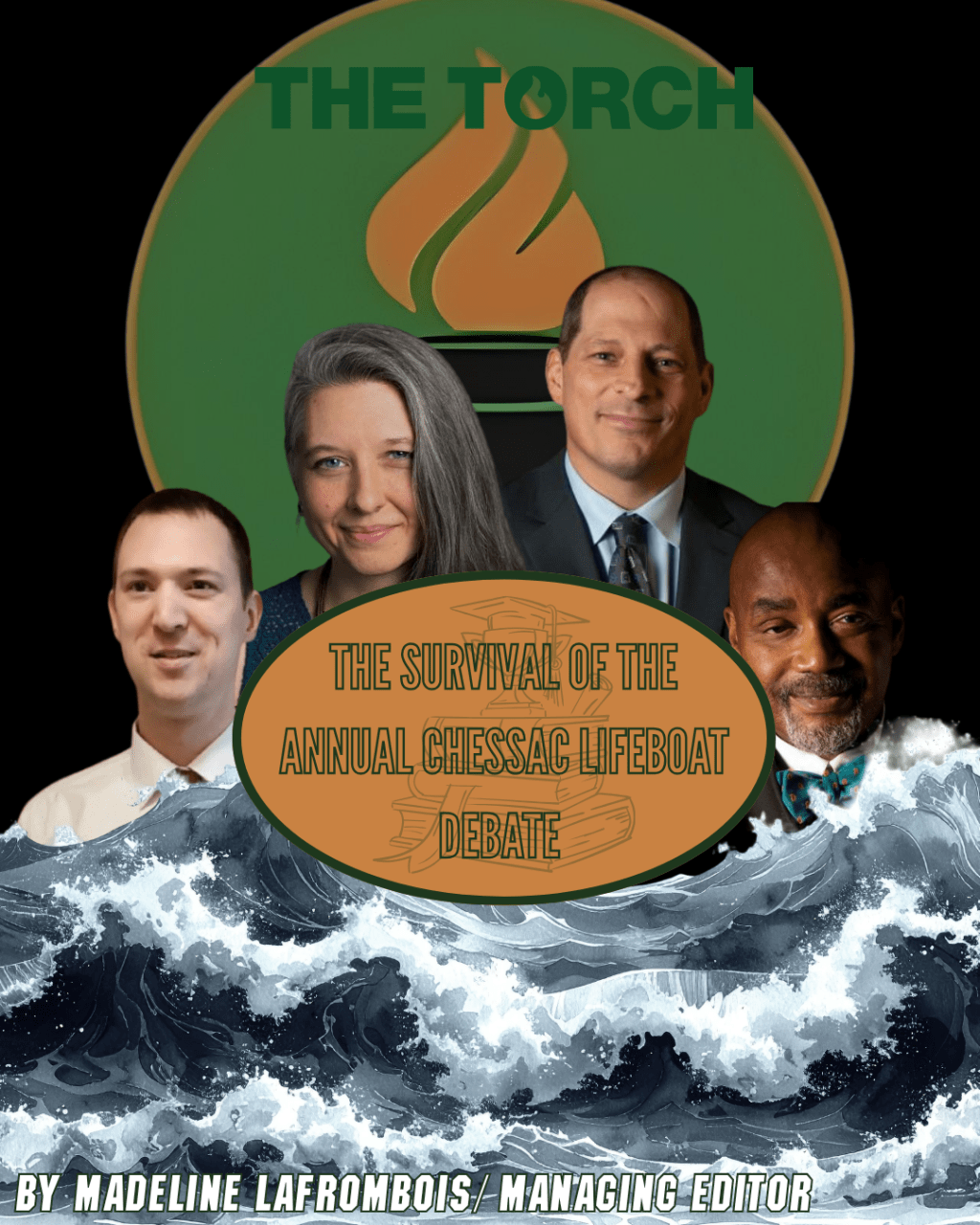
By Madeline LaFrombois | Managing Editor
On a dark and stormy late March evening at 4:30 p.m., one rogue spark from the roaring Green “L” line passing by lit a party ship filled with academics ablaze. In the rush of panic and flashes of orange and yellow light in the night sky, the ship rocks with every distressed step someone hastily takes. After only a few moments pass that seem to span a lifetime, the lifeboats are found. The thrill of safety is crushed like the rocky waves crashing against the ship’s side. As many find safety, four academic professors rush towards the last lifeboat to lower. The crushing reality hits the quartet: only one can fit. Time is ticking, flames slowly inch closer and closer towards the few still hoping to survive. Only one can survive.
Every year, the College of Humanities Education and Social Sciences Advisory Committee hosts a lifeboat debate. By posing a theoretical scenario that prompts the audience to choose one of the invited programs to survive. A faculty member in the program represents the specific area of expertise and makes the case for why their area of study should survive. Through rounds of questions, debate, rebuttal and voting, only one is left standing at the end of the tale.
The four professors, all from different departments, yet one had the most experience, knowledge, and resources from their years of academic training, to set the survivors of this horrific event up for the best chance of survival.
Immediately, the four start making their case.
Dr. Andre Marak jumps at the imaginary lecture hall whiteboard on the ship to make his case on how history holds many truths for today. How polarizing pasts can help people understand and develop ways to create economic equality. Although Marak’s position is convincing, the lifeboat debate crowd becomes suspicious as he quickly gets defensive over the expo markers hiding in his pockets, ready for a lecture at any moment.
Dr. Gerry Bouey steps in to calm the crowd after the expo markers show, using his interdisciplinary approach. His words inspire the masses with words focusing on what we have, rather than on what we don’t have. The lifeboat nods in agreement when Bouey wraps up his discussion about how college needs to start teaching life skills and how to live with one another, rather than focusing solely on academic topics.
The exhilarating argument ends with the powerful quote, “We know how to send people to the moon, but not how to love each other.”
Although Bouey’s case is incredibly powerful, Professor Blake Wallace quickly jumps into the conversation to remind the group of the quickly approaching raging fire. Wallace, a math professor, uses the opportunity to show how math can solve the practical equations of life. Wallace specifically points to how quickly the fire will reach the people waiting for someone to get on a lifeboat so they can all get to safety. Wallace shares with the debate crowd the mathematical use of tracking stars for navigation, thinking through analytical social situations like game theory, or using math as a medium for strategic conversations.
In his final plea for the seat on the boat, Wallace reminds the group, “If I weren’t there, everyone would have to do everything with computations on their own.”
Suddenly, an attack of expo markers appears. Everyone looks to Marak, assigning the reappearance of the markers to him, but he’s just as confused. Just as the foremast crashes down into the blaze that is the boat, Dr. Jennine Love rises with the smoke from the commotion to argue her case at the imaginary whiteboard with her own Expo markers to the lifeboard debate crowd. Love’s case, grounded in public administration, strikes from the start, explaining how the interdisciplinary subject focuses on social equity, on dealing with real people with real emotions, on learning and connecting with cultures, and on the ever-increasing importance of community and collaboration. Her imaginary, drawn-out graphics hit home, showing that she is an expert in mutual aid and community organizing.
Just then, a slight creaking sound echoes within what’s left of the hull of the ship. The group is silent. The creaking sound grows slowly, like a foghorn slowly encroaching, getting closer and closer. Flames burst from the center of the ship, pulling the main mast into the incinerated center. An arm is grabbed and pulled onto the lifeboat, and is quickly dropped to the turbulent seas below. The ship, succumbing to a crack, breaks in half, drowning the incinerated bow and, soon after, the stern.
As the sun peeks over the horizon, the water calms, and warmth greets the helpless little yellow lifeboats bobbing on the surface of the water.
A figure sits at the stern of the last boat, the boat that escaped last from the fire the night prior. In farewell to their colleagues, they battled for the very seat they were sitting in. Marak finally decided to share his expo markers as the victorious winner of the 2026 lifeboat debate. His victory goes to show how the crowd seemed to value someone skilled in understanding and reimagining powerful hierarchical political and economic systems when creating a new society.


Leave a Reply