
By Avery Causley-Ingram | Editor-in-Chief
“Who is the system built for and who still has to fight just to move through the door?”
Harmoni Jordan let the question hang in the air. The student success advisor for Hope and Play Scholars stood at the podium in the Ida B. Wells Lounge, facing rows of students, faculty, staff and the university’s president, all gathered for Roosevelt’s “Social Justice Day,” held this year on Trans Day of Visibility.
Roosevelt’s President Ali Malekzadeh addressed the founding of the institution: “Almost 81 years ago, we were founded by the notion of social justice, when the YMCA College, the president, was asked to provide a census on gender, race, religion, of the students and the faculty, and his response was, we don’t count that way.”
Natasha Robinson, assistant vice president for Social Justice and Advocacy, framed the day’s purpose:
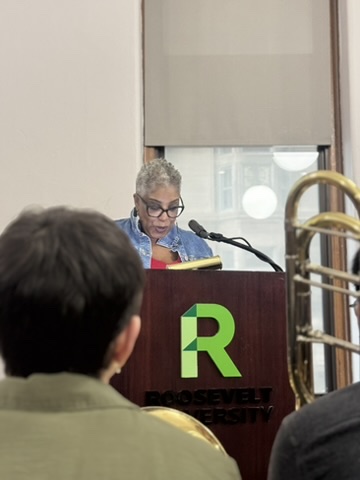
“…Social Justice Day is more than just a hashtag. It is more than just something that you see on a website. It is an embodiment, it’s a belief. And today, it is going to be about our demonstrating and understanding what justice looks like, it feels like in our bodies and in our lives.”
While administrators spoke on what social justice looks like, Roosevelt students explained how it feels to live in it.
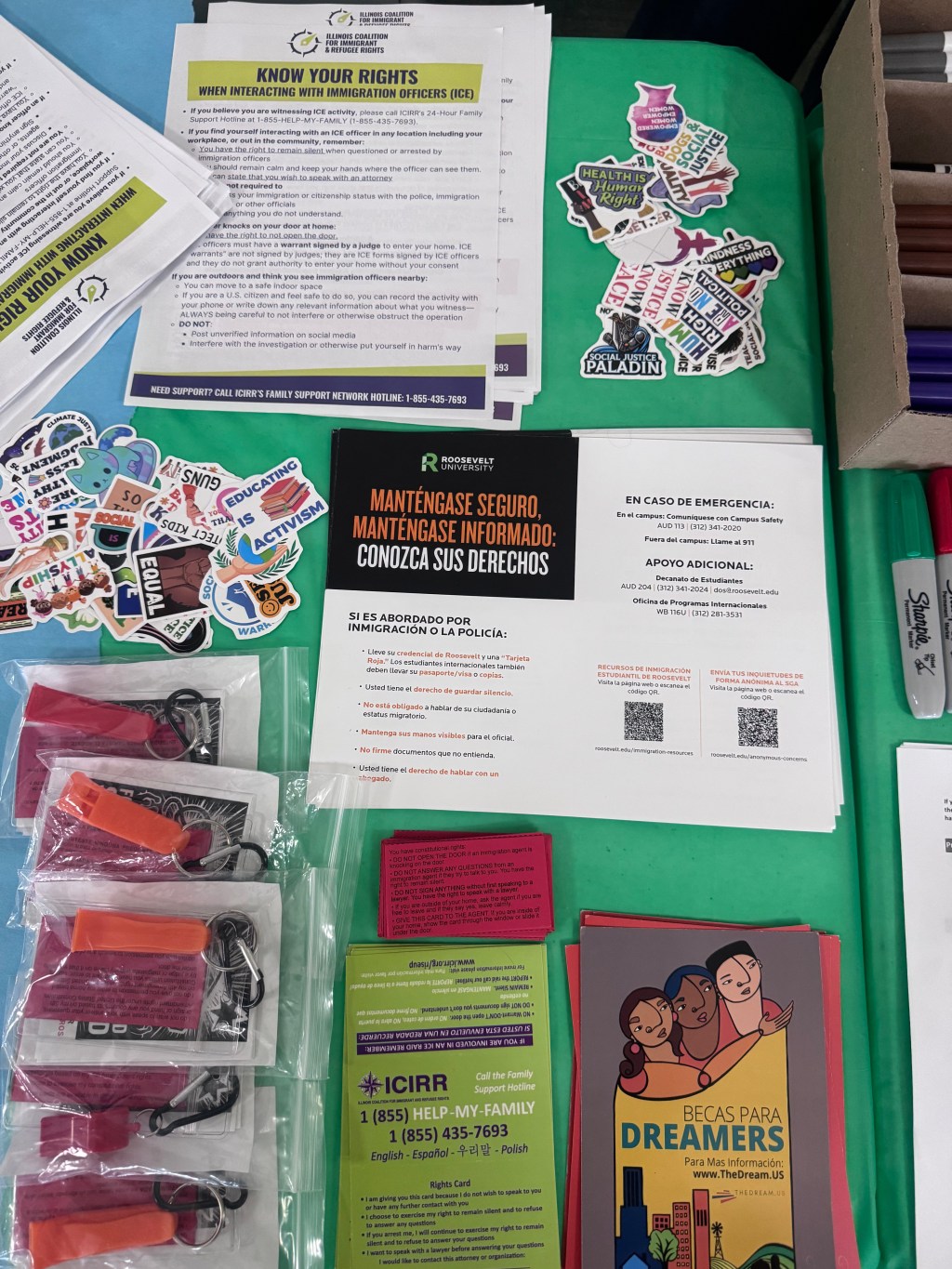
“United We Dream,” a student organization that supports undocumented students, immigrants and allies, was among the groups tabling at the advocacy fair, offering resources and community for those navigating an uncertain political climate.
Jael Rodriguez, a digital marketing, advertising and public relations major and board member of “United We Dream,” said the fear extends beyond the classroom.
“My classmates have expressed needing to miss classes and lectures out of fear for their safety when ICE activity starts to increase,” said Rodriguez.
Kay Bayer, vice president of the “Student Government Association” (SGA) and “United We Dream” member, said the university’s response has had consequences.
“We have staff that are not inviting the conversation but instead taking it as a personal attack and getting defensive. Due to this public display, we have lost student attendance as well as just overall morale of the student body,” Bayer said.
For members of “RU Proud,” Roosevelt’s LGBTQIA+ student organization, “Social Justice Day” carried extra weight as it fell on Trans Day of Visibility.
“I remember the constant anxiety when I would do everything in my power to ‘look like a man.’ Everything I did did not work in my favor,” said Michael Scarpelli, president of “RU Proud.”
Scarpelli, who is transgender, said the political climate has made visibility feel complicated and the pressure student organizations have adds extra stress.
“Registered student organizations are used to build community, they should not need to carry that heavy weight of needing to also protect them,” said Scarpelli.
“RU Green,” a student organization dedicated to environmental education and advocacy, said student engagement matters now more than ever.
“Even though policy is going backwards, it will continue to do so if we do not show that we care,” said Linda Phillips, vice president of “RU Green.”
The organization recently helped install and maintain a Mental Health Garden in the “Murray-Green” library, providing students a green space on campus.
President Malekzadeh acknowledged the limits of what a university can control.
“What happens outside our buildings, we have no control,” he said. “But as we gather together and form community, everybody feels safe.”
For Scarpelli, that sense of safety is still being built, one day at a time.
“We make up 0.5% to 1% of the U.S. population,” he said. “Most of the time trans people just want to live a normal life.”


 The Torch
Leave a comment